


Forum Statistics
- Threads
- 29,480
- Posts
- 581,952
- Members
- 29,174
- Latest Member
- Musclemuscle
You are using an out of date browser. It may not display this or other websites correctly.
You should upgrade or use an alternative browser.
You should upgrade or use an alternative browser.


testboner
VIP Member
- Oct 10, 2010
- 2,298
- 3,018
It’s that Heisenberg Breaking Bad blueI was drunk the other day and took a piss with my wife watching and she was like "wtf is your piss blue?"
I said " sorry honey I wasn't cheating so its not an std!! im taking some new blue meth shit that the boys on the muscle site recommend and apparently it kicked in!"
We still haven't spoke since

testboner
VIP Member
- Oct 10, 2010
- 2,298
- 3,018

Bigtex
VIP Member
- Aug 14, 2012
- 2,096
- 3,417
OK, you guys got me interested in this stuff and I jumped on the band wagon yesterday. First dose was 12 drops. I honestly noticed nothing later on in the day. My urine had turned a light green which I suppose means I need more. Today, 15 drops. I plan of going 5 on and 2 off. I will give it a fair shot but I am very skeptical.
This is what Grok says about dosing:
Suggested Starting Point for Methylene Blue
Dose: Start low, e.g., 10–20 drops/day (5–10 mg), sublingually or diluted in water, to assess tolerance. This aligns with ~0.1 mg/kg for your weight.
Frequency: 3–5 days per week, with breaks to monitor effects.
So I weight 240lbs / 108kgs (~11mg/d) and tomorrow will go to 22 drops/d
Solution Strength: Your methylene blue is 10 mg/ml. Assuming a standard dropper (~20 drops per ml):
1 drop ≈ 0.05 ml = 0.5 mg of methylene blue.
10.9 mg ÷ 0.5 mg/drop ≈ 22 drops/day (low end).
54.5 mg ÷ 0.5 mg/drop ≈ 109 drops/day (higher end, likely excessive for non-medical use).
My wife wanted to give it a try but she is taking Tesofensine, which is a serotonin–norepinephrine–dopamine reuptake inhibitor. Not a very good idea and the washout period for this is weeks. The Tensofensine should do the same but is more directed at curbing the appetite.
This is what Grok says about dosing:
Suggested Starting Point for Methylene Blue
Dose: Start low, e.g., 10–20 drops/day (5–10 mg), sublingually or diluted in water, to assess tolerance. This aligns with ~0.1 mg/kg for your weight.
Frequency: 3–5 days per week, with breaks to monitor effects.
So I weight 240lbs / 108kgs (~11mg/d) and tomorrow will go to 22 drops/d
Solution Strength: Your methylene blue is 10 mg/ml. Assuming a standard dropper (~20 drops per ml):
1 drop ≈ 0.05 ml = 0.5 mg of methylene blue.
10.9 mg ÷ 0.5 mg/drop ≈ 22 drops/day (low end).
54.5 mg ÷ 0.5 mg/drop ≈ 109 drops/day (higher end, likely excessive for non-medical use).
My wife wanted to give it a try but she is taking Tesofensine, which is a serotonin–norepinephrine–dopamine reuptake inhibitor. Not a very good idea and the washout period for this is weeks. The Tensofensine should do the same but is more directed at curbing the appetite.


Bigtex
VIP Member
- Aug 14, 2012
- 2,096
- 3,417
OK, 4 weeks of using this stuff. I want to see measurable effect from anything I take. So much of what is claimed is not measurable at all.
Here is what I question:
MAO inhibition, mitochondrial enhancement. In vivo, biochemical markers like, increased serotonin, norepinephrine, dopamine + decreased 5-HIAA can definitely be measured. Increased phenylethylamine (PEA) levels as well can be measured. Platelet assays, PET scans, and neurotransmitter metabolite changes are easily measured. In fact, you do do blood work to test Platelet MAO-B Activity. You can also do a urinalysis looking at Plasma Neurotransmitter Metabolites, Serotonin → 5-HIAA, Norepinephrine/Dopamine → VMA, DOPAC, HVA. Has anyone done this. I*certainly have not and most likely will not waste the money.
How about mitochondrial enhancement, can we quantify this? A simple VO₂ max test. I do this with every student I teach every semester and we use the Rockport walk test pre and post testing. A lactate threshold test. Lactate threshold (LT) testing is one of the best functional ways to assess mitochondrial efficiency, because it tells you when your body shifts from aerobic (oxygen/mitochondria) to anaerobic (glycolysis/lactate buildup) metabolism.
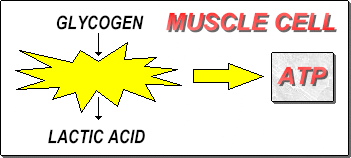
How does HR recovery times effect mitochondrial efficiency? Simple, the faster you recovery the faster restoration of energy substrates ATP & phosphocreatine. In the glycolic stage the raster your recovery the Quicker clearance of metabolic byproducts (lactate, H⁺). In the end, this means less strain on cardiovascular and autonomic systems so the mitochondria are restoring energy and clearing metabolites efficiently.
The major problem I have is testing mood, energy, cognition and skin quality. These are all very subjective and could definitely be effected with suggestions leading to the placebo effect. so after 4 weeks of this stuff, all I have been able to effectively measure is the color of my urine. None of the rest is measurable or even noticeable. Will I purchase another bottle.....most likely not.
Here is what I question:
Quantifying the Placebo Effect
- Objective Effects (e.g., urine discoloration): 0% placebo (purely pharmacological).
- Subjective Effects (e.g., mood, energy, cognition): 30–70% placebo, with MB’s pharmacological actions (e.g., MAO inhibition, mitochondrial enhancement) contributing the rest. The lower end (30%) applies if you notice clear, consistent improvements; the higher end (70%) applies if effects are vague or heavily expectation-driven.
- Skin Changes: 50–80% placebo, due to limited human data and high subjectivity in perceiving skin quality.
- Overall Average: Placebo likely accounts for ~40–60% of subjective benefits, with the rest from MB’s pharmacology, though this varies by individual and outcome.
MAO inhibition, mitochondrial enhancement. In vivo, biochemical markers like, increased serotonin, norepinephrine, dopamine + decreased 5-HIAA can definitely be measured. Increased phenylethylamine (PEA) levels as well can be measured. Platelet assays, PET scans, and neurotransmitter metabolite changes are easily measured. In fact, you do do blood work to test Platelet MAO-B Activity. You can also do a urinalysis looking at Plasma Neurotransmitter Metabolites, Serotonin → 5-HIAA, Norepinephrine/Dopamine → VMA, DOPAC, HVA. Has anyone done this. I*certainly have not and most likely will not waste the money.
How about mitochondrial enhancement, can we quantify this? A simple VO₂ max test. I do this with every student I teach every semester and we use the Rockport walk test pre and post testing. A lactate threshold test. Lactate threshold (LT) testing is one of the best functional ways to assess mitochondrial efficiency, because it tells you when your body shifts from aerobic (oxygen/mitochondria) to anaerobic (glycolysis/lactate buildup) metabolism.
30-Minute Time Trial Method (Running or Cycling)
- Warm up.
- Perform a 30-min all-out but sustainable effort.
- Record your average heart rate during the last 20 minutes → this is a good estimate of your LT heart rate.
- Corresponding pace/power at this HR = LT pace/power.
“Talk Test”
- Below LT → you can talk in full sentences.
- At LT → you can only speak a few words at a time.
- Above LT → speaking becomes very difficult.
Step-by-Step: DIY HRR Test with a Fitness Watch
- Warm Up:
- 5–10 min easy pace (walk, cycle, jog).
- Exercise Phase:
- Raise HR to 70–85% of max HR (e.g., a strong jog, cycling, rowing).
- Hold for 1–2 minutes at this steady intensity.
- Recovery Phase:
- Stop or switch to very light walking/cycling.
- Watch stays recording.
- Note your peak HR at the end of exercise.
- Measure Drop:
- At 1 minute post-exercise, record HR.
- At 2 minutes post-exercise, record HR.
Interpreting Results
- HRR at 1 min = Peak HR − HR after 1 min
- HRR at 2 min = Peak HR − HR after 2 min
- >12 bpm drop at 1 min → normal.
- >20 bpm drop at 1 min → excellent fitness.
- ≤12 bpm drop at 1 min → may indicate lower parasympathetic reactivation or poor conditioning.
- At 2 min: >22 bpm is good, >30 is excellent.
How does HR recovery times effect mitochondrial efficiency? Simple, the faster you recovery the faster restoration of energy substrates ATP & phosphocreatine. In the glycolic stage the raster your recovery the Quicker clearance of metabolic byproducts (lactate, H⁺). In the end, this means less strain on cardiovascular and autonomic systems so the mitochondria are restoring energy and clearing metabolites efficiently.
The major problem I have is testing mood, energy, cognition and skin quality. These are all very subjective and could definitely be effected with suggestions leading to the placebo effect. so after 4 weeks of this stuff, all I have been able to effectively measure is the color of my urine. None of the rest is measurable or even noticeable. Will I purchase another bottle.....most likely not.
Bigtex
VIP Member
- Aug 14, 2012
- 2,096
- 3,417
OK, here is more of what I am looking for to explain some of the more subjective results.
 pmc.ncbi.nlm.nih.gov
In more simple language - this study found that:
Exactly the evidence I was looking for! So no theoretically, using MB long term as we age could help avoid cognitive breakdowns. Certainly worth ordering another bottle.
Oral administration for conditions like cognitive enhancement is considered off-label and typically starts at a low dose of 0.5 mg/kg daily, with a maximum recommended dose of 4 mg/kg daily. May have to go up on the dosing.
Next I will look into skin changes. Sorry for all the postings but this is how I think through research.
Methylene blue modulates functional connectivity in the human brain - PMC
Methylene blue USP (MB) is a FDA-grandfathered drug used in clinics to treat methemoglobinemia, carbon monoxide poisoning and cyanide poisoning that has been shown to increase fMRI evoked blood oxygenation level dependent (BOLD) response in rodents. ...
pmc.ncbi.nlm.nih.gov
Conclusion
Task-based and task-free fMRI in this randomized, double-blinded, placebo-controlled clinical study supported the hypothesis that a single low dose of MB modulates resting-state networks in the human brain. This suggests that MB enhances resting-state functional connectivity in brain regions associated with a visuomotor task and linking perception and memory functions, while promoting task-induced deactivation of regions that overlap mainly with ventral default mode and visuospatial networks. This work provides a neuroimaging foundation to pursue clinical trials of MB in healthy aging, cognitive impairment, dementia, and other conditions that might benefit from drug-induced neuroenhancement.In more simple language - this study found that:
- Resting-state effects: A single low dose of MB increased communication (functional connectivity) between brain regions linked to perception and memory.
- Task-based effects: When participants did a visuomotor task, MB enhanced the brain’s ability to "deactivate" networks that usually need to quiet down for efficient task performance — mainly the default mode network (DMN) and visuospatial networks.
Exactly the evidence I was looking for! So no theoretically, using MB long term as we age could help avoid cognitive breakdowns. Certainly worth ordering another bottle.
Oral administration for conditions like cognitive enhancement is considered off-label and typically starts at a low dose of 0.5 mg/kg daily, with a maximum recommended dose of 4 mg/kg daily. May have to go up on the dosing.
Next I will look into skin changes. Sorry for all the postings but this is how I think through research.
Last edited: